AI Will Never Beat Humans At Creativity, But IX Spark Might Make Humans Unbeatable
Creativity is the last domain where AI can’t beat humans. It just can’t. AI can remix, predict, and imitate, but it still doesn’t know which “dots” should be connected to form brilliant ideas. That takes judgment, experience, taste, and nerve—very human things.
What AI can do, if you engineer it right, is push humans to form better ideas, faster. And that’s the mission of our new web application, IX Spark. It’s not to replace creatives, strategists, scientists or entrepreneurs, but to act as a relentless, always-on creative muse for any kind of idea—from a B2B campaign to a product invention to, sure, what to cook for dinner tonight.
A creative muse in your browser

Endless Spark cards to inspire you.
IX Spark is a web app that turns a simple request for ideas into a stream of “sparks” — idea starters designed to provoke your own thinking, not to hand you final answers (though sometimes it might).
You don’t need to be a prompt engineer. You just tell Spark what kind of ideas you want, in plain language, and the app is programmed to do the heavy lifting. A few real-world-style use cases:
- An agency creative director generating platform ideas for a CPG launch.
- A product marketer exploring product extension ideas for a medical nutrition brand.
- A CMO hunting for positioning territories, names, or activation ideas.
- A founder brainstorming new revenue streams or features.
- A teacher designing curricula, a comedian chasing premises, a novelist mapping plot lines.
Spark is built to handle “any kind of idea,” not just advertising. But if you live in the ad business, it feels like having an unfairly smart, unnervingly prolific senior team that never tires and never phones it in.
Deep Inferral Enrichment: why the ideas feel so smart
Most people now know the mantra: “AI is only as good as the prompt.” The problem is, good prompts are work. Long, nuanced, structured work.
IX Spark hides that work behind something called Deep Inferral Enrichment. You give Spark a short, human request for ideas, the AI behind Spark responds by auto-building a rich, expert-level internal prompt and persona before it ever asks a large language model for ideas. It infers what you need from the simplest of idea requests.
Example of the surface-level request:
“Give me creative ideas to help a national grocery chain get shoppers to adopt a new mobile app for digital receipts instead of printed ones.”
Behind the scenes, Spark’s AI expands that into a 1,000 word prompt including things like:
- You are a 15+ year veteran in retail innovation and shopper marketing
- You have a deep knowledge of digital transformation, loyalty behavior, and in‑store operations
- Your method of innovation blends data, journey mapping, behavioral economics, and iterative testing
- Constraints around friction, compliance, and on-the-ground store realities
The app has been engineered so that the AI consistently infers the right expert persona, the right tensions, and the right context—without you having to think like a prompt engineer. The seasoned expert is baked into how Spark behaves, so the ideas feel like they came from someone who’s actually lived the problem for years.
The user never sees the complexity. They just see ideas that feel strangely on-the-nose for the world they’re working in.
Dial up the hallucinations: Sober, Microdose, Tripping
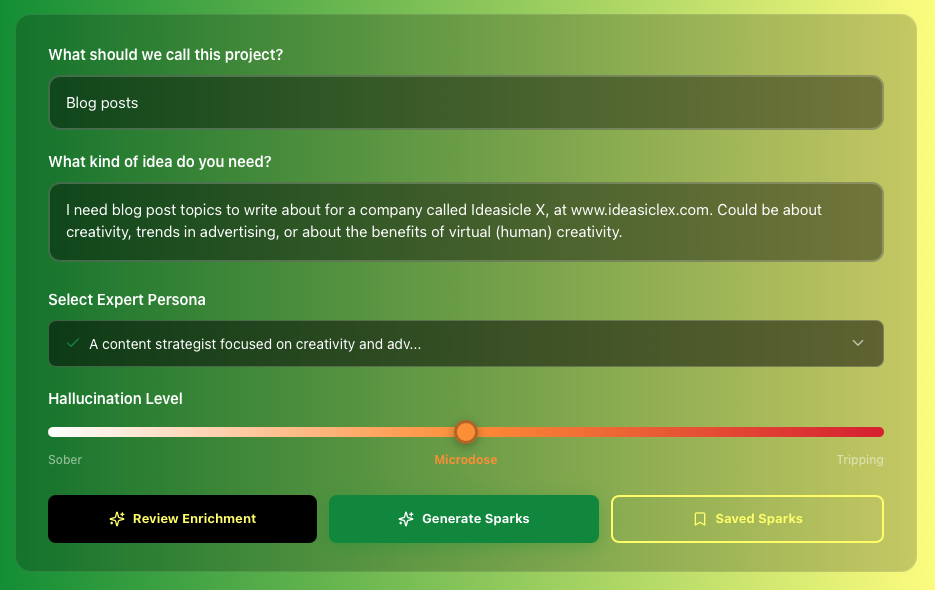
Careful with “Tripping” setting. :-)
Spark doesn’t fight AI hallucinations, it weaponizes them. Every job in IX Spark lets you set a hallucination level:
- Sober – grounded, rational, closer to what you might expect from a seasoned consultant.
- Microdose – still usable, but with weirder bridges and unexpected mashups.
- Tripping – intentionally unhinged; connection-making in places your brief would never go.
For ad people, that means you can start Sober to cover the obvious strategic bases, then push into Microdose or Tripping when you need lateral leaps, not linear logic. You control how far off the rails your AI muse is allowed to go, but the choice is up to you, not the model.
Under the hood: a real product, not a toy
IX Spark isn’t a prompt hack-taped to a chatbot. It’s a full-stack web application built and hardened like you’d expect from a SaaS product, so you can bring it into real client work with confidence.
Modern tech stack that serves the work:
- Frontend: React 18 and TypeScript, with Tailwind and a modern component library so the interface stays fast, clean, and out of your way while you think.
- Backend: Node.js and Express, written in TypeScript so the logic that powers Deep Inferral and the idea flows stays robust as Spark evolves.
- Database: PostgreSQL hosted in the cloud, using a modern ORM to keep your jobs, Sparks, and sessions structured and retrievable as your idea history grows.
- AI providers: multiple large language models orchestrated behind the scenes so Spark can lean on different engines for different kinds of thinking.
All of this is there for one reason: so when you open IX Spark, it behaves like a serious, dependable tool for your creative process—not a novelty you’re afraid to lean on.
The Spark workflow: from idea request to Sparks to Workshop
Once you’re in, the flow is intentionally simple:
1. Create a job
Describe the kind of ideas you want in a couple of sentences. Add optional context—industry, audience, constraints—if you want to steer the AI’s understanding.
2. Let Deep Inferral Enrichment kick in
Spark’s AI infers an expert persona, uncovers hidden tensions, and builds a complex internal prompt. You can see and lightly edit this “understanding” if you want to steer it.
3. Review your Sparks
Ideas stream in as cards one at a time that you can save, discard, or send into deeper development. They’re designed to be thought starters, not finished work, so you’re the curator and builder.
4. Workshop ideas “live” with two AI experts
For promising directions, you can enter a live Workshop where two different AI experts—powered by different LLMs—debate, build, and riff on your Spark with you. It’s like having a couple creative directors pushing and pulling the idea along with you, on demand.
For an ad agency, that might look like using Spark to generate 40 platform territories for a client, shortlisting three, then workshopping each one into headlines, activations, and rationales. For a product team, it might be using Spark to outline a roadmap of adjacent features, then stress-testing them in Workshop against real-world constraints.
Not another ai threat. A human hero maker.
The philosophical stance behind IX Spark is simple: the human is the hero.
Spark’s value isn’t only in the ideas it spits out on its own, it’s in what those Sparks trigger in you. The breakthrough isn’t the AI output—it’s the moment your brain collides with that output and sees something only you could see, shaped by your taste, your experience, and your understanding of the brief and the client.
Spark doesn’t ask for the credit. You don’t even have to tell anyone you’re using it! It exists so that what you think of, as a result of interacting with it, is sharper, stranger, more original, and more defensible than what you would have arrived at alone. With so many of us working remotely it’s nice to have IX Spark as a sparring partner.
Try IX Spark free
IX Spark is live, production-ready, and available for $20/month for unlimited idea projects, and it comes with two free idea projects so you can test it out before you commit.
If you work in advertising, you’ll immediately see how it slots into your process—upstream in strategy, midstream in concepting, or downstream when you’re stuck on that last headline. IX Spark doesn’t care whether your brief is for a Super Bowl spot, a new SaaS feature, a nonprofit fundraiser theme, or what to make for dinner.
So I tell you, fellow humans, creativity is still ours. IX Spark just makes it dangerous.
Sign up here: https://spark.ideasiclex.com

Will Burns is the Founder & CEO of the revolutionary virtual-idea-generating company, Ideasicle X. He’s an advertising veteran from such agencies as Wieden & Kennedy, Goodby Silverstein, Arnold Worldwide, and Mullen. He was a Forbes Contributor for nine years writing about creativity in modern branding. Sign up for the Ideasicle Newsletter and never miss a post like this. Will’s bio.